
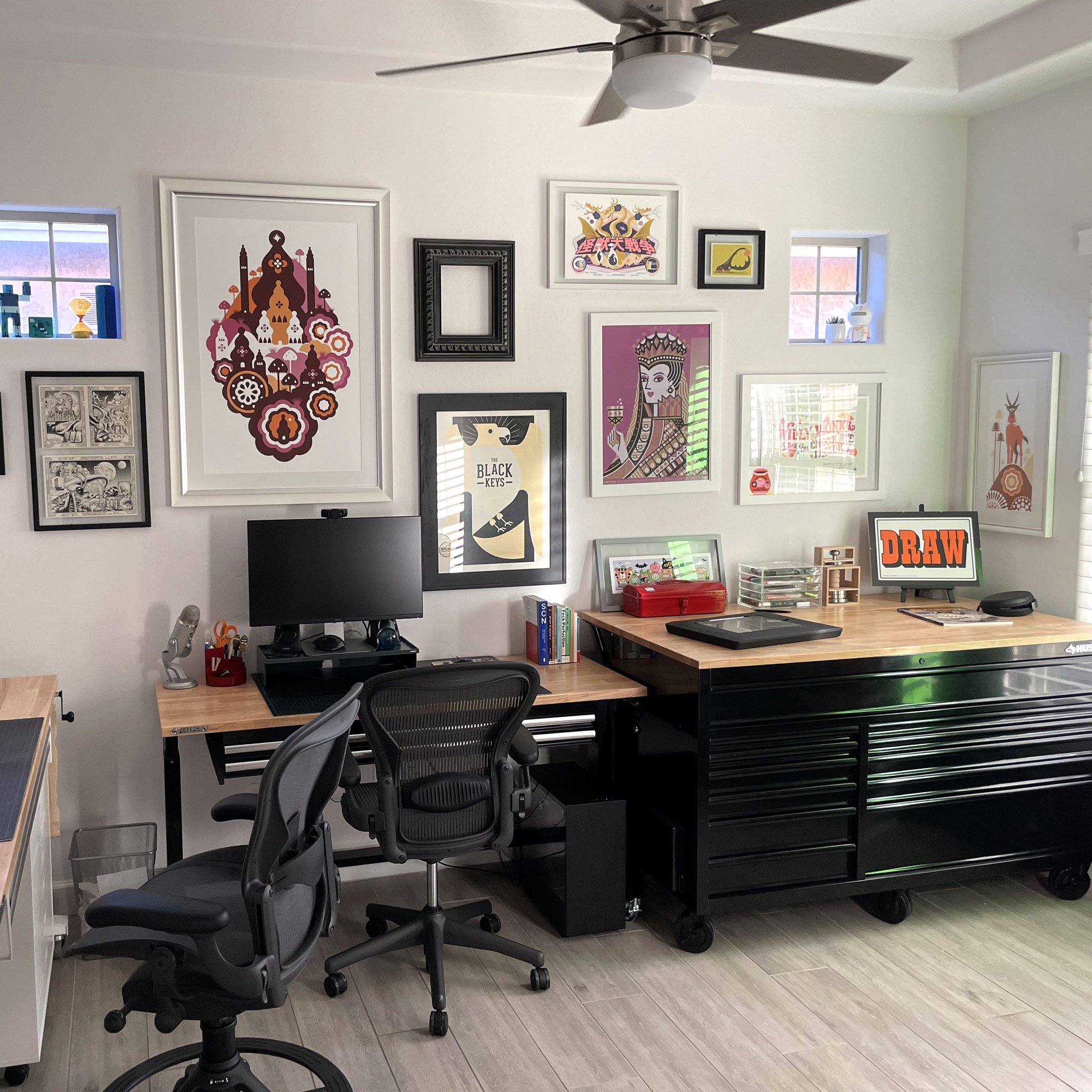
How did you get your start?
Tolleson, Arizona – that’s where I grew up. Summer reading programs at the Tolleson library introduced me to the art world. The optical world away from the small town I grew up in. Through lots of book-worming, I learned about graphic design, art history, and the many ways people make art. That little library is what started it all for me.
I didn’t know I was going to be an artist one day, I just decided to remain an artist. It was a choice.
What’s your creative process like?
I draw every day, both on sketchbooks and on my tablet. I write a lot, capturing ideas for new projects. Writing helps me narrow down which ideas to make happen. But, as a person with lots of ideas, I know I need to work at staying focused.
Most of my creative process is about working within limitations. For instance, I don’t have a giant-sized marketing budget for my studio so it’s really important that I spend time on the right things and show up at the right in-person events.
Who are your biggest inspirations?
Wow, where to start!? There’s probably a few hundred artists and designers in my “Top Five”. Locally, Janel Garza, Bob Case, Andrew Bosley, and Jon Arvizu come to mind. I’m also keeping up with work by Rachel Ignotofsky, Jamie Hewlett, Brosmind, Marion Duechars, Gaston Pacheco, and Tad Carpenter.
But most of my “art heroes” are classics. Charley Harper, Jim Henson, Mary Blair, Tolkien, Art Clokey, Beatrix Potter, Jim Flora, Ernst Haeckel, Takashi Murakami, Takeo Takei, Brian Froud, and Moebius. I carry these artists around in my head all the time.
Do you accept commissions? How do your rates work?
I do accept commissions on a case by case basis. IF a project is about collaborating to create something different, I’m interested. If a project is about doing cheap / fast work, I’m not the guy for that.
My rates are flexible and are based on the complexity of a project. After an initial conversation, I send a quote outlining my pricing. No confusing jargon included.
Some examples of projects I work on for clients are tabletop games, illustrations for use in print, digital, and apparel applications, event graphics, and iconography / emoji sets.
How do I know if I need college to be a creative professional?
If you’re self-motivated, curious about learning, a reader, and someone who makes time for growing skills, you may not need college to find success. People who take the initiative to get their own ideas done and work hard on their own, have a great foundation for being self-taught. There are many, many self-taught creatives out there.
On the other hand, if being an illustrator or designer is something you’re committed to but you need someone holding you accountable, consider the classroom environment. That’s the main benefit of being in a formal learning setting like a university or college. It can help you stay motivated, provides discipline and direction as you grow and you get to benefit from having direct input from peers and professors.
Think about these two paths. But know this: How you treat others, being a respectful person, and communicating well are going to be just as important, if not more important, than what path you take for education.
Do you prefer illustration or design work?
Both are so important to me. I’m always looking to incorporate illustration in my projects, to help tell stories and set moods. But design is important too. For instance, composing an artistic expression – painting, sculpture, music, etc. – still requires some degree of planning, purpose, and intent. By definition, those three things are design.
These days I consider myself an illustrator first. But training as a designer helped me see the deeper meaning behind the things we love, the things around us and how they work.
Writing is super-important to me as well. I see so many ways growing as a writer can give illustrators and designers a competitive advantage.
We have a unique project we’d like to collaborate with you on. How do we get started?
Please email ericsdesk@gmail.com. The best way to see if we’d work well together is for us to chat. Thank you.
Why do you live in Arizona?
I love the Sonoran Desert. It’s home. I’ve had numerous chances to relocate, but I belong here. Sure, it’s an extreme place – politics, weather, traffic. But I don’t take those things personally or assume they’re part of my story.
The creative community in Phoenix is helpful, inclusive, and ready to share knowledge. Magic, mystery, history – the desert has it all. And don’t make me explain all my food-reasons for staying here.
In short – I’ll live here till the water and AC run out. Which I really hope doesn’t happen.
What advice do you have for artists?
Keep going. Keep being you. It’s not easy to make our ideas happen or hold on to a sense of wonder. But there’s nothing holding us back from being creative. Living a creative lifestyle is connected to finding greater meaning in life, having a greater sense of purpose, and discovering more happiness daily.
If you have ideas you want to get done, make progress every day. Take tiny steps or giant leaps – either way matters. Don’t wait for permission or to be told you’re good enough. Whether you have grand dreams or small ones, start today. Looking back, you’ll be so glad you did.
Are you available to speak, host an event, or run a workshop?
Yes. Email ericsdesk@gmail.com. Let me know some basic details about your event. More info can be found here about my speaking engagements.